
Happy Black History Month
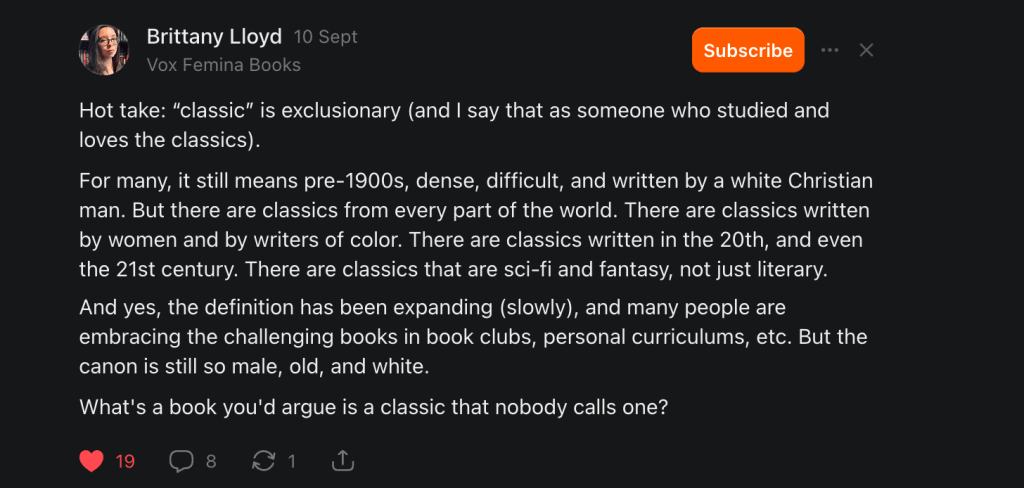
This post is an extended version of a comment I made on Brittany Lloyd’s substack, because it deserved to be an article.
Decolonisation has to be an everyday act. I know this from my own attempts: how often do you turn to the ‘worthy’ thing you might be doing, rather than the easy thing you know will bring pleasure? It might be as simple as listening to an old favourite musician rather than engaging in new-to-you culture, but in a world which privileges certain bodies and boxes others into limited ideas of who they are and what they can be even this simple act replicates power structures and compounds existing issues. There are more famous white people ripping off Black people’s work than there are people of colour in the canon. We must, then, find ways to make exploration quotidian and to understand how we can diversify culture not just at Black History Month or MLK Day, when our energies are heightened, but intentionally put Black art alongside other aspects of the curriculum as something it is obvious to teach, imbibe, and enjoy.
As a middle class white woman in a position of some power,[1] however, I think it is not simply my duty to decolonise but also, in some small way, an honour: I have been entrusted with gatekeeping the literary canon and I get to decide what is important to focus on. I wrestled with this idea when I was starting in my current post, which involved creating a library from scratch. It was really important to me that it’s a post-colonial library, but also one with academic rigour: I work in London, our children should know themselves and each other as safe, worthy, and full of potential, and my specialism as a librarian is being warm, fun, and friendly. Because we started from nothing we had the opportunity to make it a more dynamic space than most schools do, and I put a lot of research in to ensure it grows with an expansive array of heritages too. This is a guide for how I did it (and continue to work on it), and I hope it helps other librarians or even people who want to decolonise their personal reading, listening, curriculum, or other fascination, be it personal or professional.
Own Voices
I generally try to preference books written by a person from the community – that is to say, Patrice Lawrence rather than Pirates! by Celia Rees, however much I loved that as a child. The big hitters, the classic authors, are your Benjamin Zephaniahs, your Malorie Blackmans, your Jamila Gavins. I think in America Walter Dean Myers would be the equivalent. These are the people who come up when you google search ‘Black British writer’. Onjali Q Rauf, SF Said, Chinese Cinderella are all very popular in my school.
Children’s publishers and trade publications aimed at schools are better at amplifying Black voices than adult publishers, so look out for reviews or catalogues of new books, or co-writers who are often assigned to a celebrity’s work (such as Abiola Bello). It is worth noting, however, that because they often do not sell as easily as their white counterparts, Black and Asian writers are more likely to be dropped mid-contract, or find themselves unrenewed, than other races. I often buy out-of-print books second hand because it’s more important to me that my students have a good book than a shiny new book – and, sometimes, they become inexplicably popular: You Are So Not Invited To My Bat Mitzvah has flown off the shelves and developed a queue, despite me finding it somewhere down the list of books recommended by NYC Public Libraries in about 2019. I had to order my bell hooks pedagogy books from India – shame on whoever owns the rights to that! – but our school will have access to her words.
I also recommend asking colleagues of colour for what they enjoyed when young. Remember that it is not the duty of PoC to make our jobs easier, but there is no harm in politely asking if there is a particular author or story they connected with.
Translation and Abroad
I make sure we’ve got a spread of classics in translation, like Alexandre Dumas and Kenji Miyazawa – it’s always a good bet to find something that’s taught in schools in other countries or the ‘national poet’ of different regions, like Ismail Kadare and Yusuf Idris. This is even easier when considering how many countries speak English: Kereen Getten’s books about island life in the Caribbean have been very popular at my school, and there’s a huge legacy of Nigerian literature that can be tapped. If there is a particularly strong population of one nationality or language at your school, why not try searching for classics from there, such as Tissa Abeysekara’s Bringing Tony Home (great for kids who love Michael Morpurgo’s particular brand of sad animal stories) to represent a Sri Lankan diaspora?
Collaboration can be your friend here: our Latin teacher has put a tonne of work into making Classics accessible to our diverse student body, and so has written a curriculum which explores the melting pot of Rome. Your MFL department or art department may be knowledgeable in places you have gaps, so don’t be afraid to ask!
Use letters which are common in other languages to fill out your collection: at one point I looked on Wikipedia for authors whose names began with a letter we don’t use as frequently in English (I) and I might do that again (perhaps X). Our a-section is stacked from abd- and al- arabic names, and our y-section contains plenty of Chinese diversity. Common names could also be helpful for this: try looking for authors named ‘Said’ and you’re sure to find somebody you can add.
Prizes
I check things like the NAACP Awards, the Coretta Scott King medal and the Jhalak prize annually, since prizes confer an authority we can present as ‘classic’ and are usually separated into age categories, making my life easier. I’m also very impressed with the Excelsior Prize for comics, which every year seems to be a diverse selection, and I do try to buy any fêted authors of colour or people who are in the literary discourse (Brandon Taylor, Liu Cixin, Nobel winners) – even if they go in our staff section due to bad language, grisly murder, or explicit content, it’s important for children to see ‘classic’ and ‘hard’ doesn’t just mean ‘dead beardy Victorian man’ and to model diverse reading.
Biographies
People who occupy elite positions in society as biographies, such as Sophia Duleep Singh or Errollyn Wallen are ideal subjects to pique the interest of readers. Search for all kinds of odd people in history – whether the first Black arctic explorer or a Sikh pilot in WWI, an easy way to enhance the diversity of your collection is with biographies.
Diversify all sections!
I use my staff section judiciously: it’s full of my personal faves, everything from Helen Oyeyemi to Persepolis, so that children see ‘classic’ and ‘adult book’ as something more diverse and compelling than they might otherwise see – it can include comics, poetry, comedy etc. I can also speak authoritatively about why they should look forward to eg Octavia Butler, and shelved them next to all kinds of fun things like Legally Blonde and the more gruesome murder books to make them look exciting.
We carry sheet music, and have ensured that we have Alexis Ffrench alongside Chopin, Motown alongside guitar riffs, and Rihanna alongside Taylor Swift. Same for comics: whilst manga is the most popular style of comic in my library, I do also stock comics by Black authors and with clearly Black protagonists (and not just Marvel ones, though Miles Morales is a big hit). If you carry audiobooks, or separate out genres, or carry books in foreign languages, or have a ‘quick reads’ section, ensure they are also diverse so your clientele come away with the impression that Black identity does not belong to one genre (eg historical, sports, or literary) but are reminded that there are native and diasporic communities all over the world.
Treasuries
When I was young, I inherited a few ‘treasuries of children’s tales’ from my mum, and I’m going to use that word to describe things like ‘Goodnight Stories for Rebel Girls’ and ‘Murder on Summer Break’. Sometimes they’re non-fiction which share stories of people to be celebrated (I’m a particular fan of Rachel Ignotofsky); sometimes they’re bind-ups of short stories. These can be fantastic because students will approach them for one person and find themselves enjoying something they never expected. Back in the 1990s this is how I found Malorie Blackman: she wrote a story about a tennis player with sickle cell in a compendium of sports stories I picked up somewhere, and it was far and away the best story of the bunch.
Multimedia Approach
Music is an easy and engaging way to disseminate diversity. I find this particularly useful for LGBTQ+ diversity, as many students who may be off-put by an outwardly queer message can still enjoy Miley Cyrus, Frank Ocean and Billie Eilish who are out and proud. The presence of many of their favourites means that some students clamour for the LGBTQ+ or Black Innovators playlists I put together (both with no swearing and no lewd lyrics) for Pride and BHM respectively. Similarly, it’s easy to use music to demonstrate diverse presence in traditionally white spaces: Wayne Marshall (The Virtuoso Organist), Chevalier de Saint-George and Erollyn Wallen are all part of a playlist I use during BHM, and I often celebrate national days with music from a particular country. Children need to be exposed to things they wouldn’t normally and celebrate their own heritage when it’s on display, so I play music before school every morning. Sometimes it’s simple piano covers of popsongs, but often I use it as a crowbar to challenge students’ expectations of what is accessible to them.
The same goes for movies: if showing films or plays at the end of term, make sure that there are people of colour in the frame. Much Ado 1993 has Denzel Washington and Keanu Reeves, and Bride And Prejudice is a Bollywood version of the Jane Austen classic. If you have a lot of manga fans, perhaps Throne Of Blood would go down well after a term of Macbeth. Just make sure to show the faces that reflect a diverse world.
Allies
Some students are sadly subconsciously resistant to reading a book with a PoC on the cover, even if they are themselves PoC. I’s very reasonable: Black children don’t want to be given a ‘Black’ book, they want to be treated the same as their peers. This is something I think will abate in time, as a diverse catalogue encourages everyone to read diverse books, and all students will realise they can enjoy or relate to Black writers, Hijabi writers, writers in translation, or anybody who might be partially outside of their experience.
As part of this transition, I ensure our stock has characters of colour within books that are not marketed as diverse. I’m aware that ‘magical negro’ and ‘Black / Asian best friend’ are tropes we don’t necessarily want to perpetuate, but I’d personally rather children see people of colour in their books than read entirely white literature.
My number 1 pick for ally author is Meg Cabot – The Princess Diaries has fully realised characters that are of every religion, ethnicity, gender and sexual identity, and she also gave Mia a Black half-sister so that little girls of colour can be the princess too.
I already mentioned Pirates! by Celia Rees as a charming story with co-protagonists who are white and Black, and stories like The Indian in the Cupboard are an interesting way to share stories that question racism without being explicitly about it.
In Conclusion
The core thing to remember about diversity is that developing the canon is not a zero-sum game: my library stocks the complete works of Shakespeare and Dickens, I am personally an expert in German Romanticism, and much of my reading is by white authors, but I and all my students and colleagues grow from the knowledge there is more out there and that a classic can be considered differently. One of my favourite things about reading is living in somebody else’s head – why would I want all of the writers I read to be the same?
10 Diverse YA Books I Love To Recommend
- The Whale Rider by Witi Ihimaera is an adventure story which centres Māori and Polynesian experience. Sure to be loved by a generation raised on Moana!
- Bindhi Babes by Nharinder Dhami is a series I was OBSESSED with as a young teen in Leicester. A great pick for tween girls who love makeup and fashion.
- The Lizzie and Belle Mysteries by J. T. Williams is perfect for students who love all the history detective shenanigans that are very popular, and great for showing students that Black history isn’t all about slavery, but does often intersect with abolition.
- Odd Girl Out by Tasneem Abdur-Rashid is perfect for students who dream of a glamorous life but find themselves doing homework, or students who’ve moved to a new town or country and feel like a fish out of water.
- Love Is a Revolution by Renée Watson has a perfect teen protagonist – she learns not to change herself for a boy, and develops a care for something she wasn’t expecting.
- Charming As A Verb by Ben Philippe is a great story for teen boys who think they want to hustle – it’s got romance, it’s got university and grade anxieties, it’s got money-making schemes…
- Booked by Kwame Alexander is a novel in verse about sports. It’s so readable, and full of drama.
- The Ballad of Black Tom by Victor LaVelle is a really quick read re-interpreting a H P Lovecraft story. Engaging with literary history whilst writing a thrilling sci-fi and questioning existing narratives ABOUT MADNESS? We love to see it. Perfect for keen readers during exam season when they don’t have much time.
- The Icarus Girl by Helen Oyeyemi is a horror novel written by a teen girl. Show this to a mature student to demonstrate what they could be capable of.
- The Count of Monte Cristo by Alexandre Dumas is a challenging classic that is 100% adventure, allowing students to luxuriate in challenging language without getting bored.
To get this article, and others, as physical media, subscribe now.
On This Topic:
- Yes I will talk about Helen Oyeyemi with no notice, I think she’s great and I think you should read her.
- My raison d’etre is recommending books. Ask me to recommend a book for you in the comments and I will recommend you a book by an author of colour that fits your bill.
- I first started this project in my own library, decolonising my poetry collection. All those books are in storage now and the many hours of work I did feel lost to me until I get them back.
To-Do:
- Dickens Day talk!! If you see a future post that’s about wealth in Great Expectations (and kind of basic) you know why.
- Find a citation for the term ‘self-insert’
- Learn to use brush pen
Today’s Culture:
- I’m trying to get back into journalling – I fell off the wagon when I was sick with covid and I miss it, journalling is so soothing to me
- The playlist I didn’t mention but I personally prefer to play for BHM, Black Guitarists. Though I will cop that it doesn’t have Sugarhill Gang or Gil Scott-Heron, who are on Black Innovators in the hopes my students love them as much as I do.
- Yo that first chapter of Bleak House? It’s good. Who knew?
Make a one-time donation
Make a monthly donation
Make a yearly donation
Choose an amount
Or enter a custom amount
Your contribution is appreciated.
Your contribution is appreciated.
Your contribution is appreciated.
[1] I’m a high school librarian and teach undergrads at a university in the UK. I’m not exactly Oxford professor of poetry, but the world is being shaped in some small way by what I present to these kids and the language I use.


Leave a Reply