
A step-by-step guide to creating custom growth, commonplace, reflection and daily planning journals.
I have kept a journal on-and-off for what feels like my whole life. I have diaries dating back to being 12, and I currently go through one notebook in about three months. Neither the past or the present is more awkward, or full of yearning, or quotidian; each is a snapshot of where I was and what I was thinking that allows me to live with intention. I am not embarrassed to be who I was any more than I am embarrassed to be who I am, and when faced with the choices we all are I can see from these journals that I very much chose to grow up and become me.
A journal grows and becomes slowly yours. That’s why I’m writing down this method: because I have developed a method that works for me over many years, learned what to include for fun or self-improvement, and you may take from this list as I have taken from others. Beyond that, though, I find the journal itself, the artefact, a powerful visual signifier of that growth journey. You will see your notebook getting fatter, and you can know that it’s the true meaning of life condensed into the pages, whatever that means for you. A journal is your likes and feelings and half-formed thoughts that you get to finish and what is causing an emotional response and what you’re avoiding and your goals and progress in achieving them and things you learn or want to look up later . I think a journal is a great way to show that you are currently living your life. Even if it’s plans and hopes and ideas of who you might be, the intentionality required in sticking in ephemera rather than throwing it away (or, as I used to, leaving it in tins and drawers around the house ‘for the future’) requires you to curate, to be, to demonstrate what you are reaching for. It grounds you, every day, in small ways.
SUPPLIES
I’ve been very public that I use a particular brand of notebook and that I typically write with a fountain pen. If you want more information on what stationery I use then you can read that in its dedicated post, but for this you will need any notebook, several washi tapes, some glue, and a pen. That’s all.
SETUP
Front
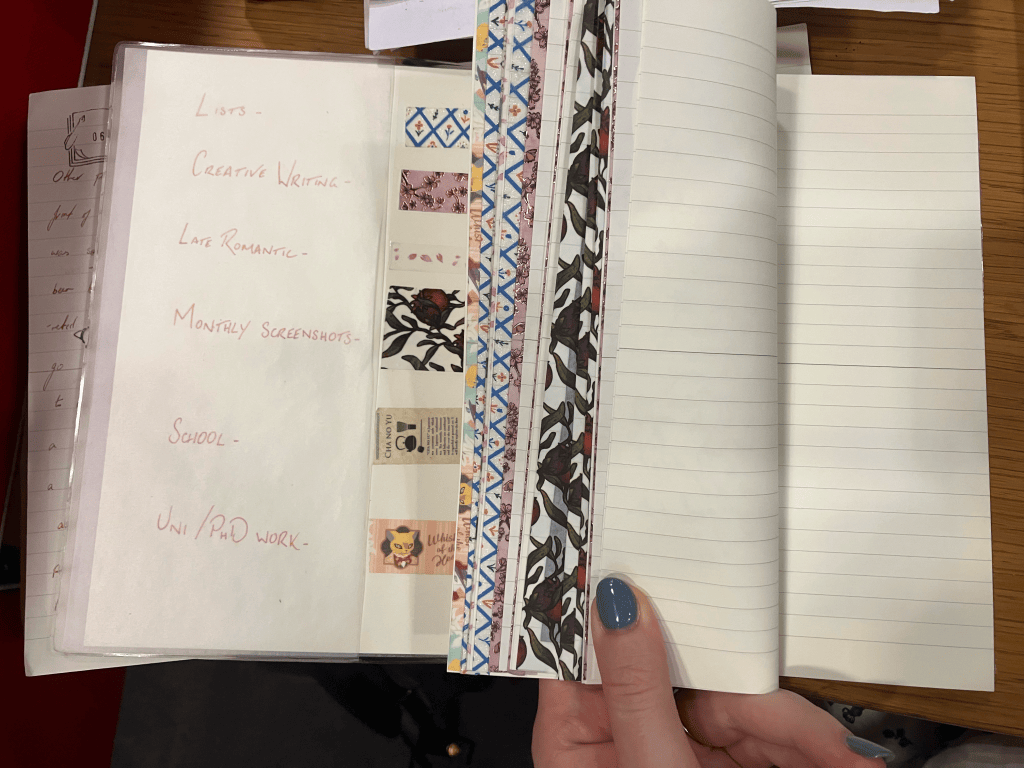
This is one aspect of my journalling method that will require some finessing from you, the individual, to make it work as seamlessly as it should, but the front is where you write the key for your washi tape. Use broad headers that you will probably use through your journal and, when you find yourself using the journal for that, wrap a strip of washi tape around the edge of your page. This transforms one notebook into an easily navigable document of all your school subjects, a password keeper, an archive of recipes, a health tracker… whatever you need.
Back
The back is several pages of setup. On my first back page I write my ‘tallies’ – that is, things I want to keep track of. In green I write ‘good’ habits I’m aiming for more than 40% in (that might be days you’ve practiced your language, days you’ve been to the gym, days you made your own lunch instead of buying it out), and in red I write ‘bad’ habits I want to cut out, and aim for under 30% of days in these (it might be where you’re spending unnecessary money, days you scrolled on IG for more than 30 minutes, days you swore at somebody whilst driving). Every time I do one of them, I score a tally mark next to it. When the journal is finished (keep track of your start and end dates) then you can work out what % of your time you’re spending how you want (for example, I stopped even tracking yoga when it came out at 2% of days for one of my journals).
The next pair of pages is things I want to track that aren’t a tally. Here’s where I have how much of my desired media I’m consuming or how much my own stats are changing – whether music and books I want to read, words written, etc. I have the thing I’m tracking on the left and how much is recorded at the beginning, then I leave space to the right to compare it at the end. For example, my last journal begins with the number of TBR ebooks at 151 and ends with the number of TBR ebooks at 193, meaning I acquired more ebooks than I read (this is bad, as it demonstrates me spending money on something I already have enough of).
On the pair of pages prior to this, I write ‘prompts’ and ‘words’. ‘Prompts’ becomes a library of things I can write when I have more time (‘what would XYZ person do in my circumstance?’, ‘should I still engage with XYZ artist who’s done a problematic thing?’) and fills up over the course of journalling as I think of things I’d like to consider; ‘words’ are simply new-to-me words and their definitions. Writing things by hand helps them go into the brain, and this is a documentation of small things I’m learning as I go along (from my last journal: diatomaceous, majolica, condign).
Optional
Use stickers or printouts to add verve to your journal. I theme mine, so in my current journal all the pictures are connected to music (I already had a lot of ‘music’ stickers and am unhauling myself). These don’t have to be on every page, but if you spread them at intervals across your notebook you will find personalised surprises as you progress. Important to note is not to stick them all in the same place on different pages: you will make the journal strangely chunky and hard to write in if you put them all in, say, the bottom right corner. You could also write quotes at random intervals, put prompts in surprise places… whatever features you would pay for in a diary, you can and should make yourself. I extend this to monthly / daily review pages: I have one made in Excel that I printed out in Filofax Pocket size that will monitor my daily study if I want it to.
ENTRIES
Ordinary writing
Each day begins with the date stamp (often backdated and put in the gap I’ve left). Each entry begins with the exact time as well as the place I wrote it, then begins. I usually write in a different colour pen if I then continue later on in the same day, but not always. I decorate around my existing ‘themed’ decorations with smaller stickers and, as mentioned, add a strip of washi tape on the edge if I find myself taking notes in a meeting or horking up something that may one day become a poem, but most journal entries are just me talking to myself and ruminating on something.
Screenshot journalling
The newest addition to my journalling stable is screenshot journalling. Essentially once a month I take stock of all the screenshots I took, pictures I saved, and all the things cluttering up my phone, and decide if they’re worth printing out to stick in my journal. I get about four pages of things that have been living in my mind rent-free, memes I can now delete, and events I actually sometimes do book now that I’m sat down in a calm space and thinking about it. These might be quotes I liked, outfits I thought looked great on some celebrity, places I want to travel to, movies I want to watch, paintings I liked, something I wanted to buy… the general mess that we are bombarded with daily which becomes sorted, and either expands my horizons or finds its historical context for some future person. As an inveterate screenshotter and generally forgetful person, I find this soothing and tidy. I generally annotate these pages to allow myself to understand the context later.
Lists
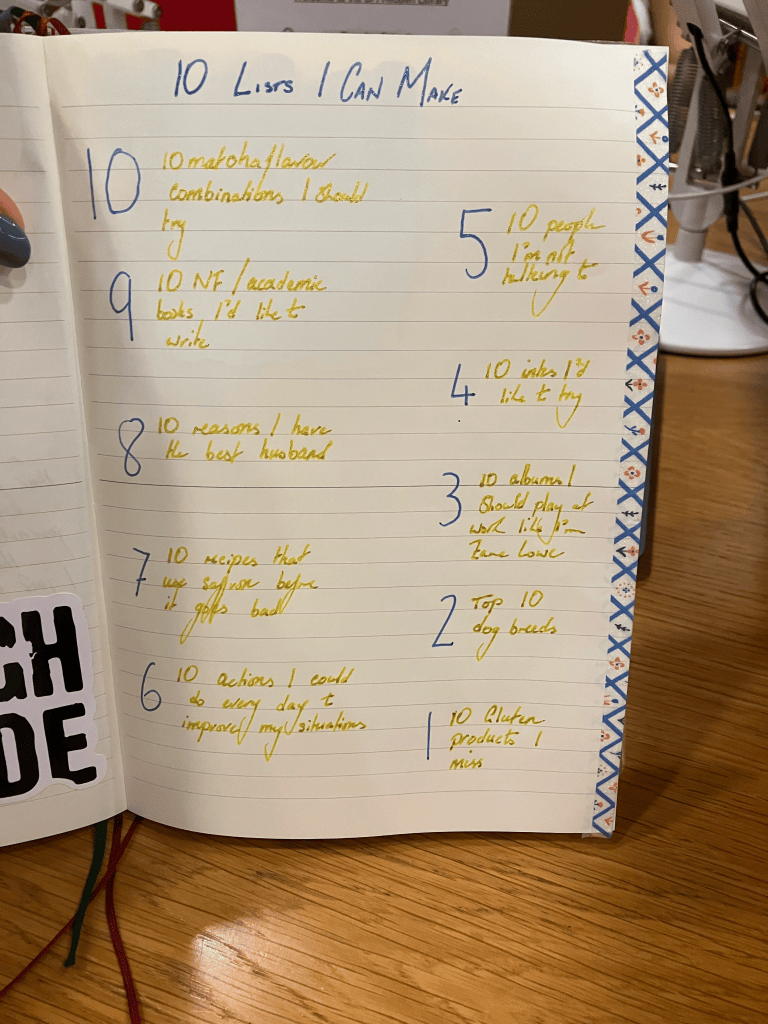
I am a big fan of keeping lists in my journal. They are always 10 things, and vary from inane ways to fill my time (’10 Taylor Swift Songs That Scream Autumn’) to efforts at deprogramming myself (’10 Fat People I Admire’) to actual goal setting, whether pie-in-the-sky (’10 Places I Would Like To Live’) or banal (’10 Events I Can Organise’). They’re silly, fun, easy, and encourage you to think laterally, which is why I think they’re a great journalling aid in a messy and stressful world.
My evergreen journalling tip is just to write often, and glue in whatever you want. The label from your boba? MEMORY. Nervous about attending an event alone? BOOM, you’re a journalist now, nobody knows if you’re the owner of this place doing analysis or just putting down your thoughts. My techniques are designed to allow me to brain dump into one place, then navigate it. They’re designed to encourage me to write, think, and reap all the benefits we know come from habit.
To get this article, and others, as physical media, subscribe now.
On This Topic:
- I’m so sorry but writing about something that gets fatter from living a good life made me think of Luisa Omielan’s thigh gap joke, and honestly didn’t that rewire all our brains for the better??
- We all feel like we’re on the sidelines of our own lives.
- Allow me to be honest about where I copied most of my journalling habits from.
To-Do:
- Drink normal water, not a litre of flavoured water every day.
- Finally play Pokémon Black & White (I & II) since I bought them for my husband for his birthday.
- TEXT FRIENDS!!
Today’s Culture:
- I follow this lady and her tarot journalling on Substack.
- Where did I get screenshot journalling from?
- This is by no means the only journalling system – BuJo is hugely popular, for example.
Make a one-time donation
Make a monthly donation
Make a yearly donation
Choose an amount
Or enter a custom amount
Your contribution is appreciated.
Your contribution is appreciated.
Your contribution is appreciated.


Leave a Reply