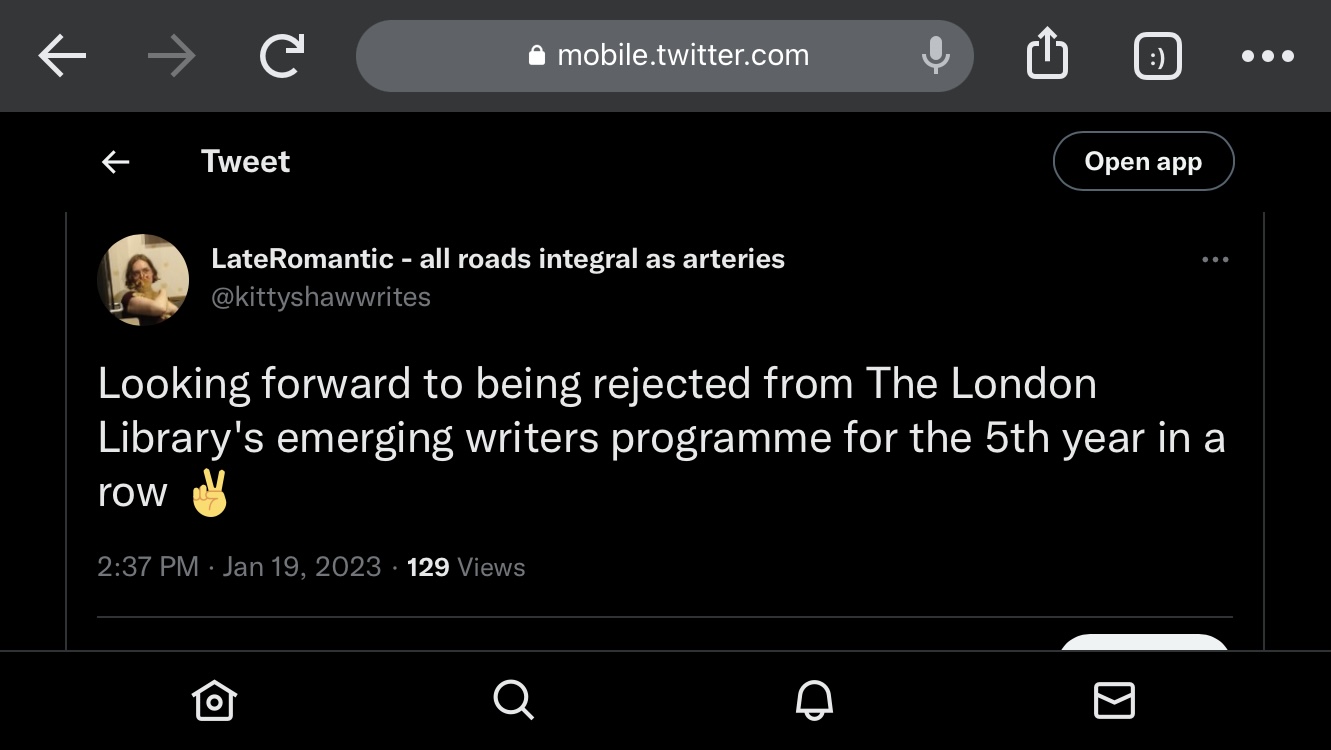
Rejections are a fact of creative life. To be honest, they’re a fact of life – especially building a life that grows with you and satisfies you instead of stagnating or shrinking. Rejection comes in friendship, in work, in creativity… and my god does it come hard and fast when you’re trying your utmost. This year I’m focussing on my creative and journalistic work (can you tell from the slew of posts?) and, yeah, it’s coming with a lot of rejections. It’s necessary to hold on to hope in the face of it all, but how?
It’s a strange sort of doublethink to hold in your head simultaneously that of course your work is worth reading, worth printing, worth people’s time to edit or share, and also that of course you’re going to be rejected. There is so much content in the world, so many different reader personalities and so many purposes to make or share art that you will never find yourself accepted to everything you want, your audience will never love you without dissenting voices, and you cannot shape yourself into the kind of person who fits into two categories, no matter how small you shrink your world. Despite that, we have to finish work, to have pride in what we’ve done, have to advocate for why we are the sum of our inspirations rather than a poor imitation of what’s come before. We have to believe it, no matter how many rejections come – we have to care enough to submit, hope and pray for an acceptance, embody what we believe in, yet be unbothered by their refusal of us.
How do you take the lessons of rejection – especially faceless rejection which does not feed back as to why – to heart, without taking the rejection itself? One thing that’s helped me is to have a reason to cling to that you were rejected: last year this was ‘I make too many references and nobody else is into Lloyd Cole, Taylor Swift, Alan Bennett, Derek and the Dominoes AND Rupert Brooke so they didn’t get my work’; this year it’s ‘well I put Taylor Swift and Thomas Wyatt as my inspirations so they think I’m giving first year Eng Lit undergraduate and won’t give my work a chance’. The important thing about this tactic is to choose something that may very well be true but that you wouldn’t remove from your work regardless – to think about artistic integrity in relation to trends in your field, what makes your own work distinctive and special, as what connects you to your art is (in my unpublished opinion) what will cause readers to love your work, rather than simply respect it. Artistic integrity does not, however, mean not growing or not learning from your contemporaries: I quite often find myself wondering why I still write stiff, formal verse when I read Momtaza Mehri and Victoria Kennefick and Ocean Vuong, and although I always return to iambic pentameter (the way I taught myself to write as a teen) I find my best poems are often the ones where I leave those confines and try to do something difficult to me. I wrote a lot of sonnets as a youth and never learned how to edit free verse – but when I get it right, you can really tell I’m inspired and moved in a way that doesn’t always come across in my self-trained practice.
I also love to ‘death of the author’ myself: they’re not rejecting me (at least, not at this stage), they’re rejecting my work. It doesn’t mean it’s not good, it means it’s not for them. This may not work so well if you’re an actor or a model, something where your personhood looks, on the surface, inseparable from your art, but still it is in the nuances where your Self diverges from your art – in your movements, the energy you chose to embody on this occasion – that is being rejected, not your inherent self. If you’re Kim Kardashian or J. K. Rowling then maybe it is your ‘Self’ that is being rejected, and perhaps if (greater or lesser) success comes for us then we the ‘Self’ is on trial as much as our work, but there are two crucial points to learn from here:
- We are only on trial so much as we show ourselves. There are plenty of celebrities who are donating to causes we agree with or don’t, plenty of celebrities who vote in a way we do or don’t agree with, and they are not facing backlash. Again, ask yourself: is it an uncompromisable part of yourself? Is it a hill worth dying on for you? I hold a lot of views, some worth vocally connecting myself with (trans rights are human rights, sorry Joanne) and some I’m more willing to let people disagree with me on (my thoughts on Harry and Meghan, though nuanced, will stay in the family because I do not care enough to share) and, should I ever be in a position where people watch what I say, I will choose my battles and my words. Once again, viewing yourself through the lens of ‘death of an author’ can be powerful: I am more than what you see, and my personhood is semi-detached from my public persona.
- We can learn from criticisms. When we are in a position to face such backlash, in amongst the vitriol and personal attacks there are people engaging with our work and, for better or worse, reading us to filth. It doesn’t mean you lack talent or connection with your audience, and in an age where everyone is a critic there is a diversity of voices criticising us. If you separate the chaff (‘shut up fat bitch’) from the wheat (‘I did not like the portrayal of this character who shares my identity’) you can grow your Self and, by extension, your work. It does not mean by any means that it is not painful, as all rejection is, but having a positive attitude about it stops you destroying yourself and reminds you of the inherent value of both your Self and your work.
The main thing that makes me feel better about rejection – whatever form it takes – is to go back to what I love, whether that’s people or actions. Laughing about it with friends, ignoring it and spending time with my partner or family, returning to my work and editing or taking on a new project make rejection feel small, help me to realise that whatever has rejected me wasn’t right for me anyway, or that I can try again next year, or that recognition – whilst being something I aim for – is not what I do any of this for. Life is long, there is always more to learn, and sharing human experiences like rejection will make your life better than it would to stay in your comfort zone. Once in a while, it may even turn out to be an acceptance, forged in the fire of all those lessons you learned and frogs you kissed…
Sharing my ratios and seeing if it helps you
POETRY: I’m pretty picky about where I submit to, and I’m hovering at roughly 35:1 rejections to acceptances in my current era. Historically, it’s been higher, honestly 1:0, but choosing my publications carefully has helped and has made me feel better because, well, at least I’m being read by people I respect.
COMPETITIONS: this isn’t even a ratio at this point, I haven’t been so much as longlisted in a competition since I was in high school. Couldn’t tell you, I’m not a winner. All the ones I was shortlisted in back then were for short stories or drama so maybe I just moved away from the forms I’m better at? Again, I’ll direct you to artistic integrity: I enjoy working on drama, but short stories I only write when I’m moved to, and poetry is worth constant work to me.
ACADEMIC CONFERENCES: maybe 4:1? This is complicated though, because you have to pay to join in, so honestly I think they’ll accept anyone who’s willing to fly to them. I’d tell any grad student to spend a year doing the circuit, applying to speak at anything even tangentially related to your research because you’ll learn so much and it will improve both your pedagogy and your research.
PAID WORK: This is from my last round of job-hunting, finding a role in publishing with two publishing roles already under my belt. The prior one was much more stressful.
Interviews: 10:1
Offers: 3:1
On This Topic:
- Struthless (again) – I really do find him the rare perspective-changing self-help content, or for another artist’s perspective try CJ the X who continues to embody what it’s like to live inside my head.
- Contrapoints (again) on her boys is kind of an interesting exploration on what conceptual rejection (and the fear therein) does to a person as an individual versus as a community.
- The ultimate thesis of this article was summed up in a much more catchy manner by Kander and Ebb: ‘What good is sitting alone in your room? … Life is a cabaret, old chum.”
To-Do:
- I have two sets of expenses to claim and should really get my shit together on that.
- Call tax office.
- Enter the two poetry competitions I’ve put to one side. Gotta give myself up to be rejected, baby!! I think these are even judged by the same person so that’s fun, I should probs send different poems too. Gotta write something fresh!!
Today’s Culture:
- I’m not over the view from my office and keep sitting by different windows because it’s like, Tate Modern one side and Palace of Westminster the other? I’m seeing into snickets and squares across the south bank and it’s amazing, if vertigo-inducing.
- Clarins beauty-flash balm has long been my fave skincare product and I just started using it again… so my skin is better. I don’t know what I was expecting.
- I’m trying to cut down the amount of sugar I have in my coffee. It is not going well.
Make a one-time donation
Make a monthly donation
Make a yearly donation
Choose an amount
Or enter a custom amount
Your contribution is appreciated.
Your contribution is appreciated.
Your contribution is appreciated.


Leave a Reply