
The method of studying is probably harder than the content. If you’re anything like me, you chose your path because you enjoy it – I’ve ensured my focus has been on literature, history, and languages since my early teens, guiding my studies to focus on that which I would read anyway, writing essays on things to work out my own thoughts in greater volume and with much more esprit than I ever do when they have to be graded; that is to say, I read a lot, and I write a lot about the things I’ve read, and I’ve got some ways of making it easier.
Many of the techniques here I have been applying for my entire academic career; others, I have picked up along the way and added to my arsenal. All of them might be good for somebody else and deserve to be used more widely, and so I present them to you. They are hardly proprietary, but I would appreciate a comment or pingback if you find them helpful, or especially if you develop them into a new method which might help us all study harder, faster, and stronger.
Finding or Creating a Study Space
Who is watching over you? I always feel guilty checking social media or reading a fiction book if I’m in the library – and that actually carries over to working generally in public. There’s only so many seats in the Waterstone’s café, and if I’m inhabiting one then I’d better be putting it to good use. This can be hacked from home with some kind of soundscape from Spotify, which is indeed how I do it sometimes. It’s good to know what suits you. Perhaps you prefer to study in total isolation? In that case, get those noise-cancelling headphones on, even if you’re in the library. Paranoid somebody may copy your notes? Get a DnD screen to hide your work from others. Friends may distract you? Go somewhere they won’t be. Want somebody on-hand to cross-reference with and ask quick questions to? Find your friends! A space can be who you’re with, where you are, and what’s around you.
How long can you sit where you are? Is your chair ergonomic, your screen at the right height? Can you take your shoes off where you are, or would you be the gremlin everybody hates in the library? (Do not ever take your shoes off in the library). Have you eaten? Will your hair get in your face? Is it light enough, and will it be for a while? Take care of your basic needs before you begin – you don’t want to interrupt your own pace with a need to address them.
Do you want white noise? Music? Music can aid recall, but it can hinder creating patterns. Consider the purpose of your study as you design the space – different curation may be required for different modules.
Put your phone somewhere else. I’m not joking – leave it to charge on the other side of the room at the very least. Phones are demons, demanding your attention like little crying babies, but unlike a baby you can silence it. Do not let yourself know that you have notifications and you will not even think of them.
Equipment
Do you have everything you need? Don’t leave books at home if you’ll be referencing them; equally, don’t sequester yourself at home if the library has the quick reference you need. Work out what kind of place you should be in and plan what you’ll be studying before you leave. A good list might include:
- Library card
- Chargers (I carry 3, and ensure they all fit into the same brick)
- At least a pencil, but likely more stationery.
- Using library books? Sticky tabs. Using your own books? Highlighters.
- A way to connect to the internet – I cannot express enough that you should back up your work even as you’re doing it.
- A watch, so you don’t need to check your phone for the time.
- Water, a protein bar, a big scarf.
- Glasses, house keys, nail file… I shouldn’t have to tell you this.
What may help you study? I’m a big fan of web blockers, which stop you checking r/taylorswift in the middle of your working. Some people may prefer to dictate their notes before tidying them (again, not a method for a communal space). There are all kinds of apps and software which can help you create your ideal study environment, and they’re worth looking into (especially since Disabled Students Allowance may even help you pay for some of them if they’re necessary to your workflow…) Even a really well-organised Google Drive (see below) can help you get where you need to go. These are all things that can be prepped whilst you’re chatting with friends or watching TV in the evening, and it’s possible to facilitate your studies even when your brain has already turned to mush for the day. Use your time wisely.
Japanese stationery is better than European or American for the student. It is optimised for actual ways it might be used, rather than how it’s already been (sincerely, I shouldn’t have to tie a binder closed with legal tape just because it’s how it was done in Dickens’ time, even if it’s cute). Invest in a Maruman binder, some aesthetic highlighters (they come in beige now! not just an arresting Brat green!!), and paper that fits your personal purpose (I use journals that are designed for watercolour sketches). There are plenty of study bloggers out there reviewing sticky notes and washi tapes and showcasing how they’re designed to help you study effectively. It’s also true that cheap products are subpar, and false economy abounds in stationery. Buy one good notebook and one good pencil before you buy a pack of crappy Bic biros that hurt your hand.
Always have a pen and paper, and make somewhere you can purge your mind of distractions. I need to buy train tickets – so I write it down to do after I finish studying. I get a cup of tea and find I need new milk – write it down, forget it, and come back to that list when you rejoin the human world later.
Consistency
My secret sauce is consistency. I use the same colour of ink to mean the same thing in all of my books, and have since I was an undergrad (green for elucidation, pink for anything I want to note, and any third colour means it’s interesting but probably not relevant to what I’m currently working on). I use the same symbols to mean the same things when I’m annotating (two exclamation marks in the margin means I will want this quote later, square brackets mean I will want to shorten this quote, an underline means it’s interesting but likely not quotable and I should cross-reference with another thinker, and so on). There are a multitude of symbols and colours that you can turn into your own personal code that is set up for the way you work: if you’re not an essay subject, maybe purple becomes something you want to look up in a lab setting, or a red star is for a diagram you will want later. I can pick up any book or paper I’ve read in my whole academic career and skim it to get what I need out of it – and I can pick up texts from my whole PhD and know which chapter I thought it would be useful for (and why) when I first read it. This is unbelievably powerful.
Routine may help you get you into the study mindset. Setting an alarm, even on days off, will help you feel fresher; setting out your desk in the way you like will signal to your body that you’re working now. Whilst you may want to do some reading in bed or on the sofa, ‘study hygiene‘ is a powerful tool, and by having a set place, time, and way you study can help you – even if it’s just the kitchen table.
The Pomodoro method is a way to keep your brain active for long periods. It’s so popular that there are a million tutorials or apps that help you do it, and the whilst it may seem counterproductive to break if you’re on a streak it can be helpful to go and drink a glass of water or even just stretch your legs. The best thing about the Pomodoro method, to my mind, is that it also times your breaks – an hour lunch is sensible; a fifteen minute walk to the Post Office is a great idea – what is not a great idea is getting sucked into scrolling or gaming or whatever your distraction du jour is. It might not be for everyone, but the Pomodoro is a great way to begin treating research like a job without it overwhelming you… and I love anything that you can personalise and make work for yourself.
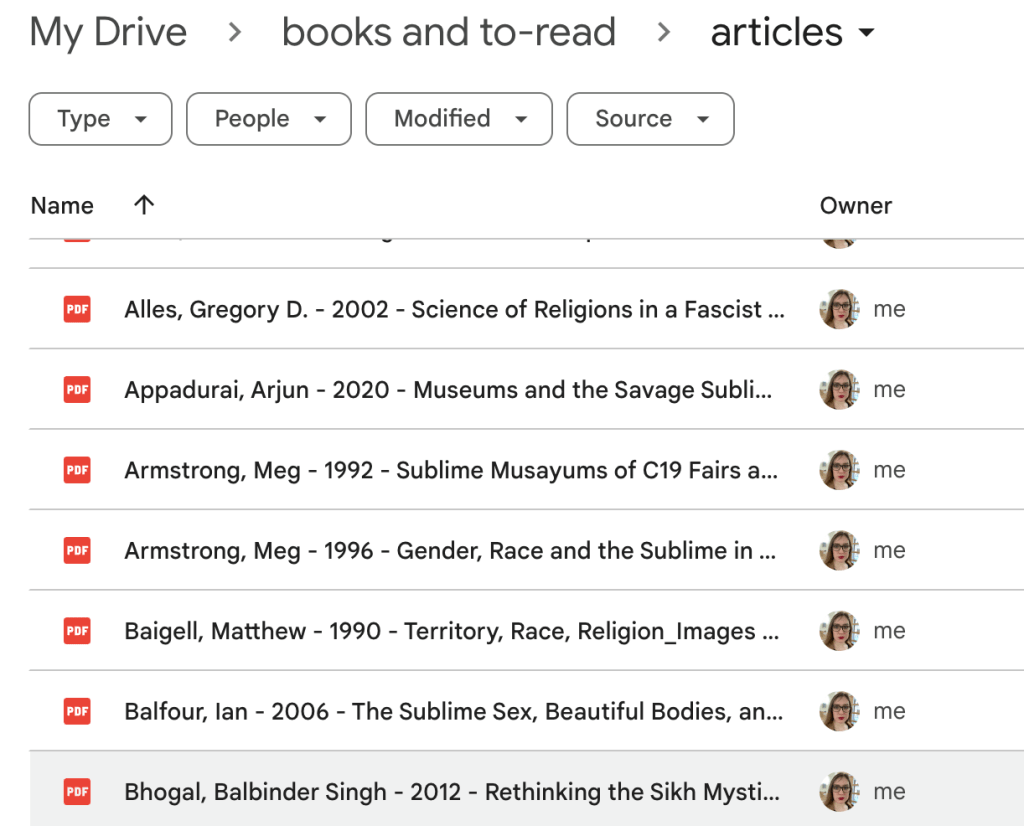
Title your documents consistently – whether they’re read or written. I am a librarian and may overkill this by doing it with my personal ebooks and organising music folders too, but trust me it is so much better to do this as you’re going along than to endlessly scroll looking for something specific. I would also suggest that this consistency involve putting the date first in anything you yourself have written – this will mean it’s easy to find the most up-to-date version when it comes to supervisions, printing, or even editing close to the deadline.

Revisiting Notes
This is secretly the most effective part of studying, and also one of the most boring. It’s obviously important to revise from your notes and readings if you will be examined on something, but if you’re writing a long research paper or will have a viva in three years you will find it much easier to consolidate as you go along rather than finding that you’ve forgotten all but the topmost summary of some important work.
Make it pretty. Use pretty inks, washi tapes, stickers or other ephemera to add embellishments to existing notes as you read through them to highlight the bits that feel important.
Transfer media. If your notes are typed, try handwriting, or vice versa – it will allow you to extract only the choicest morsels, whether that’s quotations or diagrams or your own results.
Imagine explaining your work to somebody. If you can explain your work in a way that would make sense to your seven-year-old niece, your colleague at the coffee shop, or your father-in-law – somebody so outside your field they barely know it exists – then congratulations, you understand it. I would, however, advise against doing this IRL, as it may have the side effect of them answering your calls less often.
Reference your own work! Your lit review should include something about a lot of texts, so don’t be afraid to go back through your own work and establish what you thought – it’s your project, after all!
General Tips
How are you marking your own progress? It might be something like a Gantt chart, moving papers from one binder to another, or, like me, you may prefer to tally your word count, so that even as you’re opening, copying, and saving versions of a document until you have some kind of eldritch hall of mirrors folder on your computer you know that you’re making progress and how much further you need to go.
Perfect is the enemy of good. Doing something is better than doing nothing AND you can edit it later.
‘Swallow the frog’ (ie do the shittiest thing first) is a good work technique that feels freeing.
Do your calendar at the beginning of the year, or at least the beginning of the term. I made a BEHEMOTH of a folder in my MA that was maybe the best thing I’ve ever done? By going through the handbooks we were emailed at the beginning of each term I could create a ‘contents page’ for myself (colour-coded, of course) that had: deadlines, readings for each week, advised reading around, class teacher and location, and any other information that was useful in a top-level summary. I then printed out any poems or essay prompts and filed them all. It took a long time, but that was time that would have been spent scrabbling week-to-week and allowed me to prepare my essays, always have the reading done, and be able to email a tutor without having to ask how they spell their name. Five people on the course asked me to send it to them, and they weren’t even in all of my modules.
Break up your pages. No, literally – write on the top of your books the pages that are half, a third, a quarter of the way through. Note what’s halfway through a chapter. Reading tedious things is so much easier when it’s broken down into segments and the end (or at least progress) is in sight.
Be shady in your notes! Disagree with eminent scholars, note when they do something boring or repetitive (Harold Bloom if you tell me about your curséd sleep patterns one more time…), flag when something is pretentious. These are your books and your reactions, and not only will it alleviate the pain of reading but it will also potentially be useful later on: ‘as Professor X notes… but the undercurrent of sexism inherent in his argument causes me to question how far he understood the text’. If nothing else, next time Žižek is horny on main at least you’ll find it funny and not exhausting.
Have a ‘yet to arrive’ folder in your emails where you put proof-of-purchase emails. This isn’t related to studying but is the number one organisation hack I share regularly because it helps you keep track of your money and time.
Links in this post are not affiliate – I will make no commission on them and was not sponsored to recommend these products.
On This Topic:
- My studyspiration films: A Single Man
- … The History Boys
- … and Legally Blonde.
To-Do:
- Book train tix to B’ham
- Text ur friends!!!
- Return gloves.
Today’s Culture:
- This dress, which I just got back from the dry-cleaners and am once again reminded of how versatile and lightweight it is.
- God bless Google Translate for the scholar who speaks minimal Ancient Greek and French. I will go back and properly translate any lines I end up using, but ye gods being able to skim through international and old scholarship in an hour without my head hurting makes a world of difference.
- Nicola Roberts get back in the studio challenge. She is a wonderful singer and an underrated writer and I would like to see more than a single solo album from her.
Make a one-time donation
Make a monthly donation
Make a yearly donation
Choose an amount
Or enter a custom amount
Your contribution is appreciated.
Your contribution is appreciated.
Your contribution is appreciated.
DonateDonate monthlyDonate yearly Late Romantic
Leave a comment