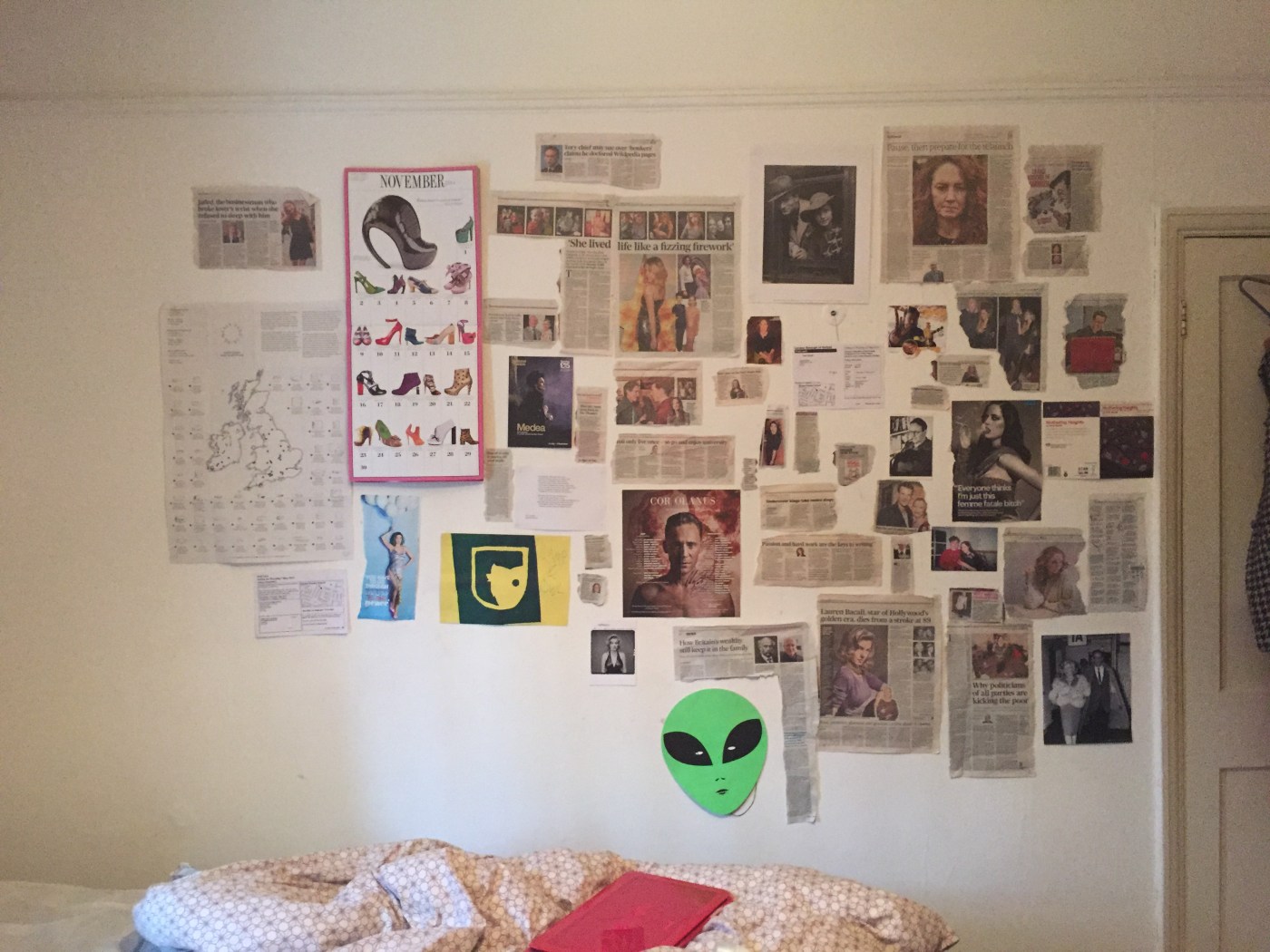
My choice to come to Birkbeck was a strange one, motivated by multiple factors that ought not to have influenced my major life choices, yet which did:
- My copy of A-Level text ‘Betrayal’ (the Pinter play) came, secondhand via Abebooks, from the Birkbeck library. Strangely, the call number was my own initials (CEMS), causing me to look up this place I’d never heard of.
- Within a month of this, I heard Eric Hobsbawm on Radio 4 and immediately bought three of his books. It is not an exaggeration to say that ‘Fractured Times’ changed my life.
- My UCAS application included four universities in a 200-yard radius of one another*. I wanted to live in London more than I cared what I was learning or who was teaching me.
- I wanted to be on University Challenge**, and Birkbeck is the London college with the most historic success.
***
I remember my Birkbeck interview well. Birkbeck interviews all applicants, unlike most highly-regarded institutions in this country who pre-select, to ensure that they can converse with the students and more accurately assess their pool. It’s no surprise that Birkbeck has a higher proportion of disabled students, or mature students, than any other university bar The Open University, because it chooses to meet them as people, as learners, as open minds rather than as UCAS forms. I remember who the interview was with (she, in fact, taught me gothic Victorians later), what the text was, and am confident my appropriate use of the word ‘Dickensian’ got me into the college. Perhaps Ana would disagree, perhaps there was some other promise I didn’t know I had that I showed her on that day, but I went from my meeting with her back downstairs, to where the group I’d met was sitting next to the cinema, to Omar, who’d also be accepted and who remained my friend all through my undergraduate before moving to America and losing touch, who I still miss.
Alma Mater literally means ‘fostering mother’; I was lucky to find mine.
***
My time at Birkbeck has seen me grow in a number of ways: firstly, I am no longer a priggish nineteen-year-old, a know-it-all who feels the need to demonstrate her knowledge. Some of that is age, naturally – let the person who was not the most irritating at that age throw the first stone – but much of it is the life experiences Birkbeck afforded me. I have sat in classrooms alongside investigative journalists, consulting doctors, mothers, refugees. I have been taught by people of all ages, races, multiple nationalities. There were moments when my classical grammar-school education was a benefit to the room, when having pretentious parents who’d had me watching French or silent movies*** afforded me some knowledge that I could bring to the discussion, but more often I was in awe of Yalda’s incredible knowledge of religious imagery and close-reading skills, aware of the insights Wiggy’s time at art school brought, bowled over by Tommy’s unceasing passion for poetry and philosophy.
Birkbeck taught me organisation – I was out here on my own, responsible for doing the reading, for juggling deadlines with paid work, for making my own revision materials. Alongside this responsibility, which has served me well as life goes on (especially in our new era of WFH and the time management requirements it brings with it) there were endless resources: disability student support, available to the mildest case of ADHD or the hardest to manage long-term conditions; student support, teaching essay writing techniques and organising group revision sessions for those who needed or wanted; the most collegiate atmosphere possible, where busy lecturers or classmates will help you – meet you to discuss the class you missed, record a class you won’t make it to, set exams that mean you don’t have to have been fully present during a course, yet still rigorously test the knowledge you should have gained along with way. Birkbeck is trust – nobody is marking you down for not turning up to lectures, even at the last minute, because everybody knows that life sometimes gets in the way. Birkbeck was a home for controversy – disagreement in class discussions, valued life experience, probing texts and questions, a hell of a research record. Birkbeck remains open to you, whether you’ve been with them before or not, whether you need to take a year or more out of your studies, whether you’re in the library at 11pm or 6am, whether you graduate ‘on time’ or take years extra.
The benefits of the Birkbeck model should be obvious, even to somebody who has never needed a place that was flexible, diverse, robust academically and accommodating.
***
I had my ‘student experience’ at Birkbeck: I slept around, I did extracurriculars***, I turned 20, 21, 22, and began to become a fully-formed person, interacted with ideas and went through phases. I made lifetime friends (and have been blessed to attend their weddings and see their babies in recent years), cried buckets over stupid things in lecturers’ offices*****, and eventually even graduated.
I was an adult at Birkbeck – I saw my own friends at things we liked to attend, not my cohort at forced fun bar crawls; I lived in a house share I chose, with adults, not on a halls-of-residence corridor with a filthy kitchen; I worked every day and paid my own way, first in typical student jobs like retail and low-level office work, then in careers I could build alongside study. I got promoted, got illegally fired, had long-term relationships and breakups during my time at Birkbeck. Life happens, and my god did I need the time they afforded me and the money their schedule let me make.
***
I have been a vocal proponent of Birkbeck for many years. I was once almost literally a poster girl for the college (although I withdrew my consent and burned the outfit I was wearing when the photos came back and I was hideous******). You can actually hear me advocate for this kind of study on the BBC as an undergraduate, but I have also shared how this model has worked for me with colleagues looking to get out of a rut, with my students when I worked in schools, at every academic conference I attended since before I even began my PhD when they were good enough to let me claim I was affiliated with them, even when I wasn’t enrolled. Birkbeck is for everyone who needs anything non-standard. I’m a Birkbecker, though and through; when I was applying for further study (MA and then PhD) there were vague applications made to other universities, but never any serious idea that I would move*******. Why would I, when I had access to the best lecturers and a collegiate department that had looked after me so long? When I knew the English department almost better than I knew my own, the Cultures & Languages team, and could (like many students partaking of the fluid ‘arts and humanities’ degree) move seamlessly among different classes and learn from so many perspectives? Isn’t that the point of a PhD? To teach, to learn, to be fucking unpaid and doing it for the love of your subject, to know more about something weird and specific than anybody else in the goddamn world?
I’m so upset by the changes that are proposed. Not only am I worried about my own supervisors and what losing them would mean for my work and my research, but I am worried for the culture that shaped me into the person I am. Birkbeck is a unique institution and I fear that the high-level administration doesn’t recognise what brings people to their college: whilst I recognise that teaching in the rafters of 43 Gordon Square where the temperature has never once been right, or in a building borrowed from UCL Astrophysics where you can’t write on the board********, has to be difficult, no amount of shiny buildings will make up for that classroom culture of discussion and incredible teaching. No budget cut should take away administrators who know everything within their remit and can answer the email you fired off in your lunch break before your class that night. As a Birkbecker for my entire adult life, I will be heartbroken if these proposals go through and I see the people I respect so much – who have made me into the scholar and citizen I am – are cut lose, their expertise and love unvalued by the college despite being the backbone of every Birkbeck experience. Any Birkbeck story is a story that testifies to the importance of this unique institution and the people within it, and the college should be supported to last another 200 years, a lighthouse in rough seas, open to everyone.
*I’m now lucky enough to live near enough to Torrington Square to walk there every day. This bears no relevance to the story, but shows that I have become somebody I wanted to be.
**It is pure laziness that I have not yet achieved this dream. And when I say ‘laziness’ I mean ‘this is not as much of a priority as other dreams of mine.’
***I should say that the pretention was almost entirely mine. Nobody made me read Orlando Furioso or order a DVD of Lon Chaney’s Phantom of the Opera as a teen, but I did and I’m not sorry, except for people who had to interact with me at that time
****For clarification, I did precisely one extracurricular – the Lamp & Owl paper – until I realised my dream of being a war reporter probably, actually, wasn’t for me and I’d be happier working towards other goals
*****Sorry Gill
******This is only half-true; I actually began working in schools and didn’t want my picture on buses around the city. Especially not such an ugly picture.
*******Except, perhaps, to Leicester, where (at the time) my parents owned a flat they weren’t living in and I might have been able to keep costs down. Therein lie several more stories, all for another day.
********This is, in fact, where I did my tragedy module as an UG.
Make a one-time donation
Make a monthly donation
Make a yearly donation
Choose an amount
Or enter a custom amount
Your contribution is appreciated.
Your contribution is appreciated.
Your contribution is appreciated.
DonateDonate monthlyDonate yearly Late Romantic
Leave a comment