This week I committed myself to something that, just one year ago, would have been very brave and very stupid: I bought a one-year pass to London’s Santander Cycles rental scheme. A year ago, I could cycle, but I hadn’t done so in two decades, and I’d certainly never done it in traffic – yesterday I cycled five miles through some of the busiest roads and junctions in the capital. How did I get here?
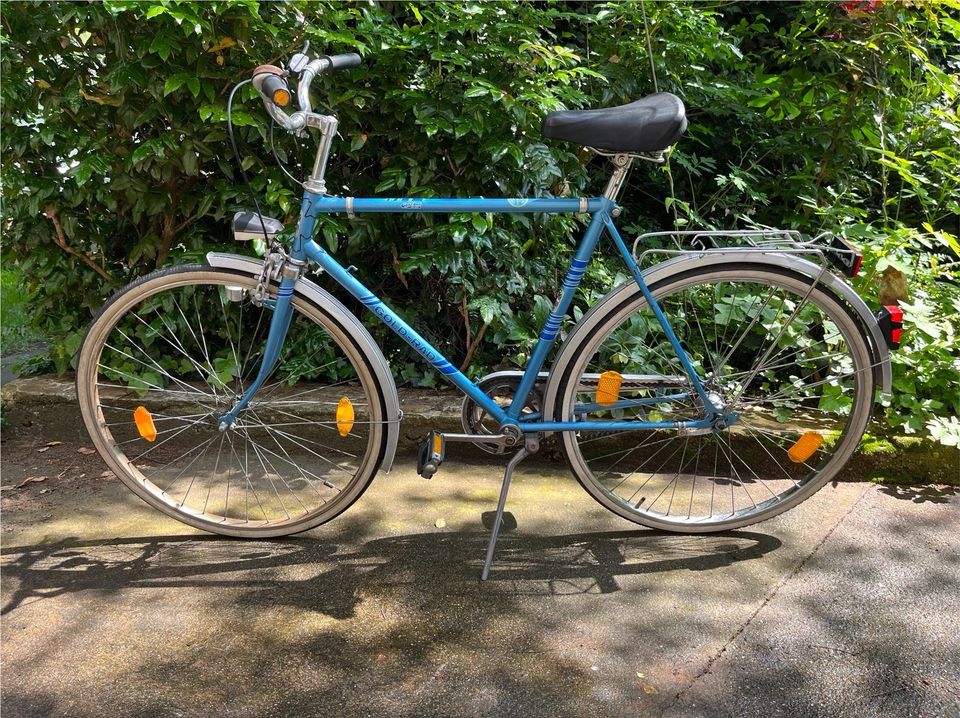
One of my main aims when I moved to Europe was to fahre mit Rad – that is, get around via bike. Two reasons I was moving were to get out of my comfort zone and live a quiet, simple life, and when I found out the school I’d been assigned to it was the perfect opportunity to live in the centre of town and take the 40-minute cycle to work as a commute. I bought myself a second-hand Goldrad from the DDR era (this is not an exaggeration) and got to it.
Cycling in Europe is a very different beast to cycling in the UK. Not only do the roads run on the opposite side – thank god I can’t actually drive and don’t have the habit of checking in my mirrors! – it’s also that the whole attitude to cycling is different, more different than you would perhaps anticipate. Cycling culture seeps into all kinds of things, whether it’s having a designated place to park your bike when you arrive at your destination or drivers being conscientious in their overtaking, and it was ideal for learning how to cycle. They say you never forget, but I disagree – and I’m here to tell you the thing you need to forget is your fear of traffic!
How Drivers Interact With You
In Europe, it’s safe to cycle even over tramlines with the tram behind you. Drivers – professional and commuter – don’t simply anticipate you, they expect you, and in six months of cycling I was only honked or yelled at once. In London, it’s a daily occurrence, and much more severe. I have had to learn to anticipate being overtaken by taxis who then turn left immediately, bus drivers who have very little patience with you, and people aggrieved that I am using the road at all.
Although I still find cycling broadly relaxing, it does mean that, unlike in Germany, I often arrive at my destination at least a little wound up, and have to let insults or selfish driving glide off me for my own safety. Honestly, this is probably a benefit in my own life – I am not good at letting things go or accepting that some things are not my fault – but often I do wish for the patience and overtaking space given to me by German drivers. The country of Autobahns is unimpressed by gaining a mere ten seconds of speed at the cost of safety.
Other Cyclists
Perhaps the reason for the negative interactions between UK drivers and cyclists is the way cyclists are perceived here. In Britain, cyclists tend to be adults who are keen on cycling – lycra bums, roadmen… even cycling clubs of twenty or thirty people dominating the road. Cycling is a serious activity, and as a result I find myself being overtaken constantly by other people on bikes who are more concerned with speed than with safety.
In the UK it’s a standing joke that cyclists often disobey road rules by running red lights or going the wrong way up a one-way street, and I’m here to tell you that, although a stereotype, in my experience it is absolutely true. In contrast, German cyclists are much more staid – they wait at red lights, don’t sneak up on the inside of other cyclists, and are hugely ranged in age. The demographic is wildly different – it’s not middle-aged men in lycra, it’s parents and children together and many, many OAPs. Road cycling is seen predominantly as a way to get to school, and as such, the rules are taught to the population at a young age and cyclists in Europe abide by them much more closely and have a greater concern for their own safety. This is something I am definitely glad I took on board as I was learning, as I am much more European in my attitudes and confidently assertive that I am doing the right thing.
Fitness as a Hobby
I was surprised the first time I asked a colleague what they’d done on the weekend and was told they went out on their bike. Mountain biking, skiing, fishing – they were done regularly by adults as well as kids. Many people were on sports teams, not just for football but for any sport you could name (I met handball players, synchronised swimmers and runners in my time there), and the public parks were regularly used for exercise – not lonely joggers pushing through (you go, joggers in the British rain! I’m proud of you!), but people enjoying their off time, playing skittles with their cousins or grandchildren. I guess this is an extension of nature being generally more culturally important in Europe, and if I were to generalise I’d say British people spend their leisure time in shopping centres and Germans spend theirs outdoors.
This is an attitude I’ve carried home – it doesn’t have to be nature (in fact, as somebody who doesn’t have a mountain bike and is scared of all things natural, I prefer it not to be), but spending time on the bike is allowing me to see parts of London I don’t normally – it’s no effort to go to Kensington or Marylebone, and the journey is the purpose for me being there so it’s cheap, too. Fitness as a hobby is much more rewarding than fitness as a chore (obviously), and using cycling to commute has given me access to it in a way I don’t think I’ve experienced before.
Potholes and Cobblestones
Pretty much the only benefit of cycling in the UK is the road quality: in London, at least in comparison to Erfurt (a town of comparable size to Aberdeen), the roads are new, and the cycle paths are paved with fresh tarmac. When you’re sitting on something with very little suspension this does make a huge difference, and I vastly prefer rounding the corners of the Quiet Cycleways or rolling around the cycle paths of London’s main roads than going anywhere in Erfurt, where I was faced with bone-shaking cobbles in the Altstadt or potholes galore on the commuter paths. Often my weekend jaunts I would find the roads near farmlands better paved!
What I will say in Germany’s favour (although, perhaps this is simply in favour of smaller towns than London) is that junctions are much easier there. Partially it goes back to the drivers and cyclists you’re sharing the road with – they are, as I said, much more generous, and this is important when you’re turning against the traffic or have to enter the main flow of traffic briefly – but it is also good city planning that anticipates where you might want to go. Whilst both places are, more and more so, planned with cyclists in mind, with designated parts of the road for bikers and even routes cutting through the city entirely given up to cyclists, in London you can get from main road to main road easily, but nobody has thought you might have a destination outside the main streets.* Erfurt accepts that you are probably going home or to work, and cycle paths weave into main routes from alleys and snickets all over the town.
Adaptability
Cycling in London has taught me to adapt – I tend to go around with my headphones on so that a satnav can direct me and I can keep to the designated cycle paths, even when I don’t know they’re there. There are roadworks and filming closing many areas, changing my paths constantly. In Germany, I was a much more routine cyclist – I had my commute to work which went along a particular route, I had my weekend exercise cycle that I tended to do over and over. London is so big that you have to be able to adapt to different routes, different road styles, and different amounts of traffic. Already I’ve been to Marylebone, Shoreditch (by two different routes) and Canada Water – very different to Germany, where anything outside the norm was planned for at least a week in advance.
Why did I keep it up?
All of the same benefits to cycling were there in London, just as they were in Germany – it’s healthy, it’s convenient, it’s cheap. Whilst many people in my life worried about my safety riding the roads of London even more than they did in Germany (thank-you to my in-laws for making me buy a helmet when I was putting it off), I relished the bike too much to give it up.
Not only is it freedom from public transport during a pandemic (a great relief, which I factor into safety concerns – the likelihood of catching Covid is, after all, much higher than me being mashed by a bus), it is freedom to do something beneficial to my physical and mental health without having to jam it into my already-busy timetable.
Cycling is only the second exercise ever I have actually enjoyed (the first being swimming, and this is neither conducive to travel nor cheap), and I like the power and freedom I feel on the bike – as well as continuing to live my fantasy life of bakeries and baskets that I found myself doing in Germany.
*This is, in fact, my main gripe with the Santander cycles – they exist only in a few core areas, none of which are close to where most of my friends actually live. The scheme is great for when you’re in the centre, but more residential areas are not served at all. Am I supposed to get the bus TO the bike, like some insane park-and-ride?
On This Topic:
- The town I used to live in, and where I learned to cycle. Look how pretty it is!
- Recreational cycling in London is possible – here’s a guide.
- The best – and most official – safety tips for cycling in the UK
To-Do:
- Dishes
- Finish Anne Brontë talk
- Charge watch
Today’s Culture:
- Am I reading this trashy romance novel to mock the rich people or to covet their life? Probably both. It’s very entertaining, anyway.
- This Pokétoon is the cutest thing I’ve ever seen.
- Trying to find a place to eat in Bank. Recommendations welcome – nowhere too boozy or small plates, please!
Make a one-time donation
Make a monthly donation
Make a yearly donation
Choose an amount
Or enter a custom amount
Your contribution is appreciated.
Your contribution is appreciated.
Your contribution is appreciated.
DonateDonate monthlyDonate yearly Late Romantic
Leave a comment