
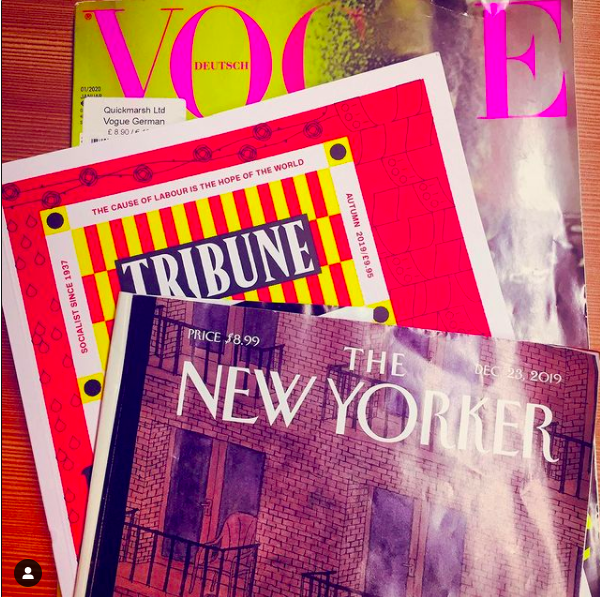
When I was younger, and very conscientious about what people thought of me, I curated the things I did to present myself in a way that I was happy with. I began drinking scotch – I thought it said ‘classic, knowledgeable, and independent’ – or, on nights out, asking for gin and cranberry juice served in a martini glass – I couldn’t afford cocktails, but I wanted to look like I could be that girl. I started wearing berets, because I wanted to be chic and cosmopolitan and classic. And, when it came to buying reading materials, I always bought the same two together – Private Eye and Cosmo. What was I trying to say with both of those publications that could not be said with either one of those? Do I still chase those ideas in a publication – and why did I feel the need to broadcast the self I wanted to be?
The answer to that final question is simple: I was young. From the ages of roughly 14 – 22 I was not a fully-formed person, yet I knew who I wanted to be; I felt that behaving as that person would behave was the closest I could come to being her, that selfhood and adulthood could be achieved through curated purchases. Perhaps the Sex and the City episodes I was too young to watch had filtered down into the zeitgeist, or perhaps I just had a part-time job and purchasing power – whatever it was, it has since worn off. Whilst I no longer have any to ostentatiously demonstrate who I am to perfect strangers – cashiers, bystanders, fellow shoppers – many of the habits I picked up then have stuck. Back then I chose to become a habitual Starbucks drinker: people who live in New York and LA always had takeaway coffee cups, and also because working on a laptop or reading in a coffee shop seemed like a sophisticated thing to do. It was a moment of great joy when the Barista in Highcross Leicester (opposite the Waterstone’s) remembered my order, and it felt so sophisticated to have a ‘usual’ that I upped my consumption even more. Whilst I no longer hold those notions I conceived about city life, the positive memories and associations with the brand from that time keep me going back. It’s now considered ‘basic’ rather than sophisticated, but it still makes me happy to have a paper cup filled with sugar slick. I don’t disagree with my teen self that it’s a combination of our interests and desires that give us a unique perspective, but I no longer feel the need to actively curate that – or that it’s something that needs to be asserted through what I buy.
On a school holiday, in Gatwick Airport, I had this discussion with a friend. She agreed with my thesis about needing two magazines, and bought the FT and Glamour whilst I queued up with my picks. We both wanted to show two sides of ourself, and thought it was especially important as women in a female-centric environment to showcase the dichotomy that we embody – strong, intelligent, girly. In a world that didn’t believe those things could exist together, that the frivolities of makeup and pop music undermined the more serious pursuits of business and politics, we felt the need to prove we had both to the world outside our happy bubble of smart women. So was it the all-girls’ school that made me feel like I needed to be two people? I don’t think that’s fair. The all-girls education put my own femininity at the forefront of my mind and pushed a bluestocking brand of feminism – that we girls should strive to succeed, yet by being surrounded by a female culture many of us found traditionally female pursuits to be fulfilling, and enjoyed them without shame. The friend I mention here went on to be named Head Girl at our school, and has been working on making a name for herself in the financial sector. If one were to analyse her magazine choices, it would show her ambition, and the direction of it, but also a desire to enjoy life – that the ‘how to spend it’ section of the FT is poe-faced and focussed on status symbols, where Glamour shows cheap lipglosses and sundresses that bring a brief, but more achievable, high. Bought together, you see somebody whose interests are in finance, large companies, and success, but also in the minutiae of life, who seeks not to inhabit a world of suits but rather to exist in it. And my choices? Private Eye shows both seriousness and whimsy – a search for the ridiculousness in serious subjects. Cosmo is also quite serious, but in a different way, encouraging a methodical approach to spinning classes and sex lives and horoscopes. Cosmo doesn’t share the mellifluous ‘fashion’ sensibility of other women’s glossies, which made it ideal for a 16-year-old who sought to craft herself into an adult. Here is the crux of it: buying two magazines does not simply put you in two camps, which marks you as a dynamic and multi-faceted person; what I did not understand at the time, but which I now know, is that the combination reveals something fresh about you, the buyer. Private Eye and Cosmo together show, yes, somebody who values both ‘highbrow’ and ‘lowbrow’ culture, but also somebody who lacks direction but not ambition, who laughs a lot, and who expects better – of themselves, and of the people in power. Lana del Rey knows it: there’s a reason her lyric goes “I’ll pick up all of your Vogues and all of your Rolling Stones“* – one alone does not tell her listener enough to extrapolate from.
Alan Bennett’s marvellous treatise on education, The History Boys (which, I suppose I should mention, many of my schoolmates and I consider to be a formative and sympathetic text) includes pockets of Gracie Fields songs and snatches of Brief Encounter, which, the audience later learns, are part of a campaign of “sheer, calculated silliness” on the part of the teacher – an “antidote” to being the kind of person who talks about “the lure of language and their love of words”. In many ways, this is what my friends and I were doing: asserting that, alongside our seriousness about academics (the school trip I described was with my Latin group; we made jokes about impluviums and Ovid the whole time), we were still teen girls. We remain women with feminine interests, and working in masculine fields or valuing typically masculine things like politics or finance does not detract from that. That, however, would be a very second-wave-feminism way of looking at it, and a little two-dimensional. Describing these combinations as ‘calculated silliness’ makes us look at what calculations exactly we were doing – and the calculation that jumps out to me is about direction. Like The History Boys, we were young and therefore learning. Even in adulthood we continue to learn. It is from what we read that we learn – articles shared in facebook feeds, reddit threads, and published media all converge into our minds, and by buying two totally opposite publications what we are doing is choosing to hear different voices. The effect of this is not unlike watching both Al Jazeera and CNN – we do not become wholly one thing, and instead take on board multiple perspectives. Reading two magazines predominantly written by white people a decade ago might not look like intersectionalism, and certainly wasn’t progressive or boundary-breaking, but to my mind the “calculated silliness” taught us to value different perspectives and seek the “antidote” to both dry intellectualism and conventional femininity.*
That girl of a decade ago should be happy – whether I always was the person I wanted to be or whether I fashioned myself into her, my life now resembles the life she wanted, and I don’t have to try to embody the dichotomy – it simply is. These days, my publications of choice are The New Yorker, and then either Harper’s Bazaar or Vogue Deutschland (though I have a long list of glossy publications I would interchange dependent on the covers. I tend to buy more based on the advertised contents, and am not aversed to GQ-type mens’ magazines). Although I don’t buy them together any more, due to no longer needing to assert a sense of self to the universe at large, I think that, ultimately, it says the same things now that I wanted to see then: I strive for ‘intellectualism’, but also fashion and makeup and adverts for handbags I’ll never buy. Essentially, whatever your interests are you should pursue them, but even if we buy thoughtlessly we read from our soul. Our very essence can be contained in something as frivolous as a magazine – but probably not just one.
* [Edit from 2025] I just realised this is actually a reference to Joni Mitchell’s song California. Maybe Joni knew instead.
*neither of which actually require an antidote if we just do things we enjoy. People are not one-dimensional beings and ‘basic’ is sexist and classist, I only accept it as a joke.

To-Do:
- Get jabbed. If you hear of anyone giving 2nd shots of Moderna, I want to hear about it.
- My nails. I don’t care if I have a million things to do, I will feel a sloven if I allow my nails to get chipped and be deeply disappointed if I break one.
- Finish Capital chapter 1 and notes!!!! This NEEDS to be done, and the vax is taking up all my time!!!
Today’s Culture:
- If you haven’t seen the Defender of the Basic then you are missing out – it alleviated my internal guilt at engaging in girly things. Bonus, Brennan does great DnD work – I like this.
- Canned bamboo shoots. I bloody love this veg, and it’s even more versatile than I imagined – today I had it soy-and-sesame glazed in a ramen, but you can also just throw them in a weekday stir-fry and make it instantly more exciting.
- Cycling – this week I’ve been out on the London rental cycles and it’s so nice to see the city this way. I’m super glad I learned to road cycle in Germany first, though!
Make a one-time donation
Make a monthly donation
Make a yearly donation
Choose an amount
Or enter a custom amount
Your contribution is appreciated.
Your contribution is appreciated.
Your contribution is appreciated.
DonateDonate monthlyDonate yearly Late Romantic
Leave a comment